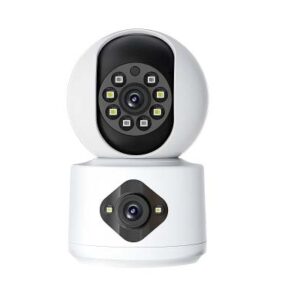
Outdoor security monitoring often involves more than simply recording what happens in front of a camera. Farms, residential properties, warehouses, parking areas, and construction sites may have different monitoring requirements. A single viewing angle may not provide enough visual information for every situation, especially when the monitored area has multiple access points or changing activity.
This is where two-view monitoring becomes useful. A dual-lens security camera provides two viewing perspectives within one camera system, helping users observe outdoor environments from different angles. When combined with solar power, mobile connectivity, and intelligent detection features, it can offer a practical solution for locations where traditional wired surveillance is difficult to install.
ANJIA’s solar dual-lens camera combines 4MP video, 4G connectivity, pan-and-tilt movement, and solar-powered operation. Its configuration addresses several common challenges in outdoor security applications.

🔍 1. Two Viewing Perspectives Provide More Monitoring Flexibility
Outdoor properties rarely have identical surveillance requirements. A farm may need to monitor an entrance and an equipment storage area, while a warehouse may require visibility around a loading zone and an external access road.
A dual-lens camera introduces two viewing perspectives into one device. Depending on the lens configuration, users can obtain additional visual information about the surrounding environment without relying on a conventional single-view camera alone.
This design is particularly relevant when selecting an outdoor surveillance camera for properties with different observation requirements. Buyers should examine the viewing angles, lens specifications, and camera movement capabilities to understand how each lens contributes to the monitoring setup.
ANJIA’s dual-lens solar camera provides 4MP video and supports 340-degree horizontal pan and 85-degree vertical tilt. These movement capabilities give users greater flexibility when adjusting the camera’s viewing direction. They can reposition the camera to inspect different parts of the monitored area instead of relying on one fixed viewing direction. For outdoor security applications, the combination of two viewing perspectives and pan-and-tilt adjustment offers a flexible approach to monitoring changing environments.

☀️ 2. Solar Power Makes Remote Installation More Practical
One of the main challenges of outdoor surveillance is supplying continuous power. Some properties have limited access to electrical outlets, while others require cameras in locations where running cables would increase installation time and cost.
A solar powered security camera can reduce dependence on a fixed electrical connection. It uses a solar panel to collect energy and charge its internal battery, supporting operation in suitable outdoor conditions.
ANJIA equips its solar dual-lens camera with a 7.5W 6V solar panel and a 7800mAh rechargeable battery. This configuration supports solar-powered operation without requiring users to connect the camera directly to a conventional power supply.
The actual charging performance depends on sunlight exposure, installation direction, weather conditions, and the camera’s power consumption. Buyers should therefore evaluate the available sunlight and expected operating conditions before selecting a solar security camera for a particular site. For farms, remote properties, construction areas, and outdoor storage locations, solar power can make camera placement more flexible and reduce the need for extensive power wiring.
📶 3. 4G Connectivity Supports Surveillance Beyond Wi-Fi Coverage
A camera may have suitable imaging capabilities, but network access also determines how effectively users can monitor a remote location. Many outdoor sites do not have a stable Wi-Fi network. This creates difficulties for conventional wireless security cameras that rely on a nearby router.
A 4G security camera provides another connectivity option. Instead of depending on local Wi-Fi, it uses a compatible mobile network to transmit surveillance data. This can make remote monitoring more practical in areas with suitable cellular coverage.
ANJIA’s solar dual-lens camera supports 4G connectivity, allowing users to deploy the device in locations where fixed broadband or Wi-Fi infrastructure may be unavailable. Before installation, buyers should confirm local network coverage, supported frequency bands, and SIM card requirements.
The camera also uses H.265 video compression. This technology helps reduce video file sizes while maintaining useful image quality, which can improve storage efficiency and reduce the amount of data required for video transmission compared with less efficient compression formats. For remote outdoor security projects, the combination of 4G connectivity and H.265 compression supports a more practical surveillance setup.

🌙 4. Dual-Light Night Vision Helps Maintain Visibility After Dark
Outdoor security risks do not disappear when daylight ends. Equipment yards, farm entrances, parking areas, and residential surroundings may still require monitoring at night.
Night vision technology helps cameras capture useful images in low-light environments. However, different night vision configurations can produce different results, so buyers should understand the lighting system before choosing a device.
ANJIA’s solar security camera features dual-light full-color night vision. This lighting configuration supports color imaging in suitable low-light conditions and provides another option for nighttime observation.
The camera also includes PIR, human, and motion detection. These functions help identify activity around the monitored area and can support event-based alerts. PIR detection responds to changes in infrared energy, while human detection and motion detection provide additional ways to identify activity.
Detection performance depends on environmental conditions, camera positioning, sensitivity settings, and the characteristics of the moving object. Correct installation and configuration remain important for reducing unnecessary alerts.
For outdoor security applications, combining night vision with multiple detection functions helps users monitor activity beyond regular working hours.
🔊 5. Two-Way Audio Adds a Communication Function
Video surveillance provides visual information, but some situations also require direct communication. For example, property owners may want to speak to a visitor near an entrance or communicate with someone working at a remote location.
Two-way audio allows users to listen and speak through a compatible camera system. This adds a communication function to the surveillance process instead of limiting the device to video recording.
ANJIA integrates two-way audio into its solar dual-lens camera. When supported by the connected application and network conditions, users can communicate remotely through the camera. This feature can be useful for residential entrances, farm access points, storage areas, and other locations where users may need to respond to activity without physically approaching the camera.

💾 6. Flexible Storage Helps Manage Surveillance Footage
Recording and reviewing footage are essential parts of an outdoor security system. Buyers should consider not only image quality but also how the camera stores recorded video and how users access it later.
ANJIA supports TF-card storage up to 128GB as well as cloud storage. Local storage provides an option for keeping recordings directly on the device, while cloud storage offers another way to manage video footage remotely.
The choice between these storage methods depends on recording requirements, available network capacity, subscription arrangements, and data retention preferences. Buyers should check the supported cloud service and any associated costs before deployment.
Together with 4MP video and H.265 compression, these storage options give users more flexibility when planning their surveillance setup.
🏡 Choosing the Right Dual-Lens Solar Camera for Outdoor Security
Two-view monitoring is useful because outdoor security often involves multiple observation needs rather than one fixed viewing direction. However, the effectiveness of a camera also depends on its power supply, network connection, detection capabilities, night vision, and storage options.
ANJIA’s solar dual-lens camera brings these functions together in one outdoor surveillance device. Its 4MP video, 340-degree pan and 85-degree tilt, 7.5W solar panel, 7800mAh battery, 4G connectivity, dual-light full-color night vision, and two-way audio support a range of outdoor monitoring requirements.
For buyers evaluating a dual-lens solar camera, the most important step is to match its specifications with the actual installation environment. Consider the monitored area’s layout, available sunlight, cellular coverage, recording needs, and desired viewing perspectives before making a decision. A well-matched camera system can make outdoor surveillance more flexible and easier to manage across different applications.