Uma câmera externa fixa pode fornecer imagens nítidas e monitoramento confiável, mas sua maior limitação é simples: it can only see what is within its fixed field of view. That may be enough for a doorway, entrance, or small area. For larger outdoor spaces, no entanto, people and vehicles rarely stay in one place.
This is where an outdoor PTZ camera becomes more useful. Instead of monitoring from a single fixed angle, a PTZ camera can change its viewing direction and follow activity within a wider area. The goal is not simply to capture more video, but to give security personnel more control over what they are watching.
The Problem With a Fixed View
A fixed camera is designed around a predetermined viewing angle. Once it is installed, changing the monitored area usually means physically adjusting the camera or adding another unit. For a warehouse yard, parking area, building perimeter, or other open space, this can create blind spots. A wide-angle lens can help cover more of the scene, but a wider view also means distant objects occupy fewer pixels. You may see that something is happening without being able to observe the details clearly. PTZ technology approaches the problem differently. It allows the camera to move toward an area of interest instead of forcing the entire scene into one static frame.
Why Pan, Inclinar, and Zoom Matter
The value of PTZ comes from combining three functions. Pan changes the horizontal viewing direction, tilt adjusts the vertical angle, and zoom allows the camera to examine a distant subject more closely.
These functions work together rather than independently. A camera can first cover a broad area, then move toward a particular location when activity is detected, and finally use zoom to obtain more useful detail. For outdoor surveillance, this flexibility can be more practical than simply increasing the number of fixed cameras.

Tracking Matters When the Scene Changes
Outdoor monitoring becomes more difficult when people or vehicles are constantly moving. A fixed camera may capture a subject entering the scene but gradually lose it as the subject moves outside the original viewing area.
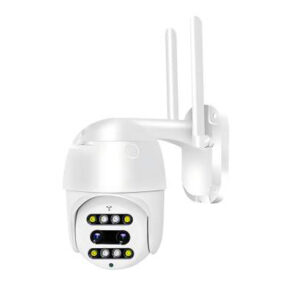
A PTZ security camera with intelligent motion and humanoid detection can respond more dynamically. The ANJIA Q812 5MP Outdoor PTZ Camera can automatically track human movement while providing 360° horizontal and 90° vertical rotation.
Its horizontal movement can reach 30° per second, while vertical movement can reach 20° per second. These capabilities allow the camera to reposition itself as the monitored scene changes, rather than relying entirely on a fixed viewing direction.

Wide Coverage Still Needs Image Detail
Coverage and image detail are two different requirements.
A camera may cover a large area but provide limited detail when the subject is far away. Conversely, a camera with strong detail at a narrow angle may leave too much of the surrounding area outside the frame.
This is why PTZ cameras are useful for larger outdoor scenes. The camera can maintain a broad monitoring range while using its movement and zoom capabilities when closer observation is needed.
The Q812 uses a 1/2.7-inch 5MP image sensor to provide clearer video and image detail. Combined with PTZ movement, this gives users more flexibility when monitoring subjects at different distances.
Night Monitoring Cannot Be an Afterthought
Outdoor surveillance does not stop when daylight disappears. Lighting conditions can change quickly, particularly around parking lots, entradas, armazéns, and building perimeters.
The Q812 combines full-color night vision with 36 white LEDs for color visibility in low-light conditions. It also uses 8 infrared LEDs for stealth monitoring at distances of up to 15 metros. The important point is not simply having multiple lighting modes. A useful outdoor camera needs to maintain practical visibility as the environment changes from daytime to nighttime.

Outdoor Reliability Is Part of the Camera
Movimento PTZ, qualidade de imagem, and detection functions have little value if the camera cannot handle the environment where it is installed.
Outdoor equipment has to deal with rain, pó, temperature changes, and long operating periods. The Q812 uses an IP66-rated housing for protection against dust and water, making it suitable for outdoor surveillance environments.
Connectivity is also part of installation flexibility. The camera supports both Wi-Fi and Ethernet, while storage can be handled through a TF card of up to 256GB or optional cloud recording.
When Does a PTZ Camera Make More Sense?
| Monitoring Requirement | Fixed Camera | Câmera PTZ externa |
|---|---|---|
| Small fixed area | Suitable | Suitable |
| Large outdoor area | May require multiple cameras | More flexible |
| Moving subjects | Limitado | Better suited |
| Changing viewing direction | Not available | Available |
| Distant subject observation | Limited by fixed view | More flexible with zoom |
| Outdoor night monitoring | Depends on model | Depends on model and lighting system |
A fixed camera is still a practical choice when the monitoring area is small and predictable. PTZ becomes more valuable when the scene is larger, subjects move frequently, or the viewing direction needs to change during monitoring.

A More Flexible Approach to Outdoor Surveillance
The main advantage of an outdoor PTZ camera is not simply that it has more functions. It is that the camera can adapt to the scene instead of forcing the scene to fit a fixed viewing angle.
For applications where people, veículos, and activities can appear in different locations, that flexibility can make a meaningful difference. With 5MP imaging, Movimento PTZ, rastreamento inteligente, visão noturna, áudio bidirecional, and IP66 protection, the ANJIA Q812 is designed around this type of changing outdoor surveillance environment.
The right camera is ultimately determined by the scene. When the area is fixed and predictable, a fixed camera may be enough. When the monitoring task changes with the environment, a PTZ camera offers another level of control.