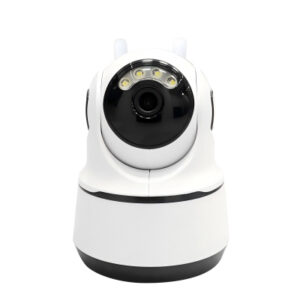
Choosing an indoor security camera is not always about getting the highest resolution. In many real installations, the bigger problem is coverage. A camera may have a clear image, but if part of the room sits outside its viewing area, there is still a blind spot.
This is one reason dual-lens indoor cameras are becoming more practical for indoor surveillance. With two imaging channels and flexible camera movement, they can cover more of an indoor space without relying on a single fixed viewing direction. For offices, stores, reception areas, homes, and other indoor environments, that difference can be more useful than simply adding more pixels.
Anjia’s dual-lens indoor camera is designed around this idea. It provides 4MP dual-channel monitoring, with up to 340-degree pan and 65-degree tilt control. The result is a camera that can be adjusted across a much wider area when the monitoring point changes.
The Limitation of a Single-Lens Indoor Camera
A single-lens camera is not necessarily a poor choice. In a small room with one obvious monitoring point, it can do the job very well. The problem appears when the room has several areas that need attention.
Take a small shop as an example. The entrance may be on one side, while the checkout counter and product shelves are several meters away. Mounting a camera in the corner may give a reasonable overall view, but one area will often receive less attention than another. Moving the camera can improve one angle while making another worse.
The same situation happens in offices. A camera may be installed to watch the reception area, but the corridor or another section of the room may fall outside the most useful viewing angle.
This is where camera movement and lens configuration start to matter. Instead of asking only, “How clear is the image?”, it is worth asking, “How much of the area can I actually monitor from this installation point?”

Why Two Lenses Can Make a Difference
A dual-lens indoor camera gives the system more than one imaging channel to work with. That does not automatically mean it will replace two separate cameras in every project, but it can make better use of a single installation position.
Anjia’s camera uses two channels to provide 4MP monitoring while supporting 340-degree horizontal movement and 65-degree vertical movement. This gives the camera considerably more flexibility than a fixed indoor camera.
For a security integrator, this can be useful when working with spaces where activity is not concentrated in one place. The camera can be adjusted toward different areas instead of being permanently locked into one viewing direction. There is also a practical installation benefit. Adding another camera means another mounting position, power connection, network connection, and device to manage. A dual-lens solution may not eliminate that need in larger surveillance systems, but for smaller or moderately sized indoor areas, it can simplify the setup.

Coverage Depends on More Than the Lens
It is easy to look at the word “dual-lens” and assume that wider coverage is guaranteed. In practice, the installation environment still matters. Room size, camera height, wall layout, furniture, lighting, and the distance between the camera and the monitored area all affect the final result. A dual-lens indoor camera installed in the wrong position can still leave blind spots.
That is why camera placement should be considered before installation. Corners, entrances, open work areas, corridors, and areas with frequent movement may require different viewing angles.
The 340-degree pan and 65-degree tilt control of Anjia’s camera gives installers more room to adjust the viewing direction after the camera has been mounted. That flexibility can be particularly useful when the actual site is different from the original project drawing.

Monitoring Does Not Stop When the Room Gets Dark
Lighting is another part of indoor surveillance that is sometimes overlooked.
An office may look bright during the day and become almost completely dark after employees leave. A retail store can also have different lighting conditions between opening hours and closing time. A camera that performs well only under good lighting is not enough for continuous monitoring.
Anjia’s dual-lens indoor camera combines infrared and white-light night vision. The two approaches allow the camera to continue monitoring when ambient light is limited.
Human detection and motion detection are also included. These functions can make recorded footage more useful by helping identify movement or people within the monitored area rather than leaving users to review every second of continuous video.
For businesses, this can save time. Security footage is most useful when people can quickly find the events that actually matter.
The Network and Storage Side Matters Too
A camera may have good imaging hardware, but it still needs to work reliably within the customer’s network.
Anjia’s dual-lens indoor camera supports dual-band Wi-Fi and Bluetooth pairing. This gives users more flexibility during connection and setup, particularly in indoor environments where wireless network conditions can vary from one location to another.
The camera also uses H.265 video compression. Since continuous surveillance produces a significant amount of video data, compression efficiency becomes important for both network traffic and storage. The actual storage requirement will still depend on factors such as resolution, frame rate, scene movement, and recording settings, but efficient encoding can help make long-term recording more manageable.
For storage, the camera supports a TF card of up to 128GB as well as cloud storage. Users can also view the camera through a phone, PC, or NVR. This gives the product more flexibility for different installation and monitoring requirements.
A small business may prefer simple phone access, while a larger security project may already have an NVR-based system. Being able to work with different viewing methods makes the camera easier to fit into existing workflows.

Two-Way Audio Is Useful in Everyday Situations
Another feature that tends to become more useful after installation is two-way audio. For example, a camera near a reception desk can allow staff to communicate with someone without being physically present. In a shop, it can provide another way to respond to activity near an entrance. In an office or other managed space, remote communication can sometimes be just as useful as video monitoring.
This is a good example of why a security camera should not be evaluated only by resolution. The overall experience depends on how the camera handles video, movement, detection, communication, storage, and remote access together.
Where Does a Dual-Lens Indoor Camera Make Sense?
There is no need to use a dual-lens camera everywhere. If a room is small and a single fixed view covers everything that matters, a conventional camera may be enough.
A dual-lens indoor camera becomes more interesting when the monitoring area is less straightforward. Small commercial spaces, offices, reception areas, corridors, stores, and other indoor environments with several points of activity are typical examples.
For B2B buyers and security integrators, the decision should therefore start with the site rather than the specification sheet. Look at where people move, which areas need continuous monitoring, where blind spots may appear, and how the customer expects to access the footage. Then consider whether a dual-lens camera can solve those requirements from one installation position.
Looking at the Camera as Part of the Whole System
The biggest advantage of a dual-lens indoor camera is not simply having two lenses. It is having more flexibility in how one camera is used.
Anjia combines dual-channel 4MP monitoring with 340-degree pan and 65-degree tilt control, along with human and motion detection, dual infrared and white-light night vision, two-way audio, H.265 compression, and both local and cloud storage options.
For an indoor security project, these functions work together. The lenses provide the imaging channels, the pan and tilt mechanism helps adjust the view, detection functions help identify activity, and the network and storage options determine how users actually manage the footage.
That is ultimately the reason to consider a dual-lens indoor camera over a conventional single-lens model. It is not simply about having two lenses. It is about getting more usable coverage and more flexibility from the same monitoring point.