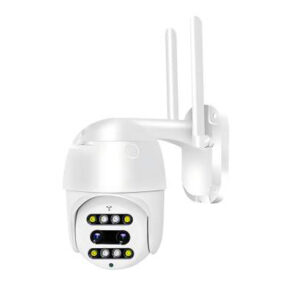
Outdoor security projects rarely involve one fixed monitoring point. Construction sites, фермы, склады, парковки, and remote properties may cover large spaces. These locations can also lack reliable power and network infrastructure.
A dual-lens solar camera offers a flexible option for these environments. Two lenses can monitor different areas, while solar power reduces the need for fixed electrical connections. Depending on the model, features such as high-definition video monitoring, smart motion and human detection, night-vision monitoring, mobile viewing and control, двусторонняя аудиосвязь, and local storage support can further improve outdoor surveillance.
Why Do Large Outdoor Projects Need a Different Camera Approach?
A small residential property and a large outdoor site have very different monitoring needs. A large project may include several entrances, open areas, equipment zones, storage spaces, and remote locations.
Traditional wired cameras can provide stable connections. Однако, installation may require power cables, network infrastructure, protective conduits, and other construction work. Extending this infrastructure across a large site can increase installation time and cost.
Solar-powered cameras offer another approach. When a location receives enough sunlight, the solar panel can help power the camera. This reduces the need for a conventional electrical connection at every monitoring point. This approach can work well in areas where infrastructure remains limited. Buyers should still evaluate sunlight, погода, battery capacity, and installation conditions before deployment.

How Does a Dual-Lens Design Improve Coverage?
The main value of a dual-lens camera comes from its ability to provide different views. Two lenses can monitor separate directions or areas, depending on the camera design.
A single lens usually focuses on one viewing direction. This can leave blind areas across a large outdoor site. A dual-lens configuration may cover nearby zones without requiring another camera at every position.
Например, one lens could monitor an entrance while the other covers an adjacent road. A similar setup could work around a warehouse, parking area, or construction site.
Actual coverage depends on the lens specifications, mounting height, угол обзора, и положение установки. Project teams should therefore plan camera locations based on the physical layout of the site.
How Does High-Definition Video Support Outdoor Monitoring?
Wide coverage is useful only when the camera captures enough detail. High-definition video monitoring helps users view people, транспортные средства, оборудование, and other activity more clearly.
Image quality becomes even more important when cameras sit far from the monitored area. Clear footage can help security teams review events and identify activity that needs attention.
Resolution is not the only factor that affects image quality. Lens performance, освещение, высота установки, and image processing also play important roles. Buyers should evaluate the complete imaging system rather than compare resolution numbers alone.

How Does Smart Detection Reduce Unnecessary Monitoring?
Large outdoor sites can generate constant movement. People may enter and leave, vehicles may pass through, and environmental changes can affect the camera view. Smart motion and human detection can help identify relevant activity, depending on the model. Instead of watching every camera feed continuously, security personnel can focus on events that require attention. This becomes more useful as the number of cameras increases. Manual monitoring across many screens can consume significant time. Smart detection can help reduce this workload. Buyers should also consider false alarms. A useful detection system should identify meaningful activity without creating excessive unnecessary alerts.
Why Is Night-Vision Monitoring Important?
Outdoor security often continues after sunset. Construction sites, парковки, фермы, and remote properties may still require monitoring during the night.
Night-vision monitoring allows compatible cameras to capture useful images in low-light or dark conditions. This gives security teams another way to monitor areas when natural light is limited.
Night performance depends on the camera hardware and the surrounding environment. Infrared capability, lighting conditions, installation distance, and weather can all affect the final image.
For this reason, buyers should evaluate night performance based on the actual installation environment rather than rely on the presence of a night-vision specification alone.
How Does Solar Power Simplify Remote Camera Deployment?
Power availability remains a major issue in outdoor surveillance.
A camera near a building may have easy access to mains electricity. A camera installed at a remote gate or field may not. Running power cables to every location can add construction work and increase installation costs.
A solar-powered camera can reduce this dependency. The solar panel generates energy during suitable daylight conditions. The battery then supports the camera when sunlight is unavailable, depending on the product design.
Solar performance depends on several factors. These include sunlight exposure, panel positioning, погодные условия, battery capacity, and local climate. Project teams should review these conditions before choosing a solar camera.
How Does Mobile Viewing Make Large Projects Easier to Manage?
Security teams do not always work beside the camera system. Site managers may need to check a location from an office or while moving around the property.
With mobile viewing and control, compatible cameras can provide remote access through a supported smartphone or other mobile device. Users can check live views without staying beside a dedicated monitor.
Remote access can also simplify multi-point monitoring. A manager can check different locations from one device and respond to activity more quickly. The available mobile functions depend on the camera model and its network setup. Buyers should confirm supported devices, connection requirements, and available controls before deployment.
What Role Does Two-Way Audio Play in Security Monitoring?
Video provides visual information, but some situations also require communication. Two-way audio communication allows users to listen to the monitored area and speak through the camera when the model supports this function. This can help at gates, входы, service areas, and other locations where remote communication matters.
Например, a site manager can communicate with a visitor at an entrance without immediately walking to the location. Staff can also use the function to provide simple instructions when needed. Two-way audio does not replace on-site security procedures. It adds another communication channel to the monitoring system.
Why Does Local Storage Matter in Large Projects?
Large surveillance projects can generate a significant amount of video data. Local storage support gives users another way to save and review recordings. Local storage can be useful when users need to review previous events. It may also suit projects that prefer to keep recordings within the local camera system or associated storage equipment. Storage capacity and recording methods vary by model. Buyers should check storage type, capacity, recording duration, overwrite settings, and file access before deployment.
Can a Dual-Lens Solar Camera Work in Different Environments?
Outdoor projects can have very different installation conditions. One site may need cameras around a warehouse, while another may require monitoring across farmland or a construction area.
Indoor or outdoor use according to the model gives buyers more flexibility when selecting equipment. Indoor models can suit protected areas, while outdoor models can handle locations exposed to environmental conditions.
Buyers should consider mounting position, weather exposure, освещение, viewing distance, and power availability. Network conditions may also affect the final camera choice. Matching the camera to the installation environment can improve long-term reliability and reduce unnecessary replacement work.

What Should Buyers Consider When Planning a Dual-Lens Solar Camera Project?
Camera selection should start with the site rather than the product specification sheet.
First, identify the areas that require monitoring. These may include entrances, vehicle routes, storage areas, equipment zones, and perimeter locations.
Next, consider whether a dual-lens design can cover multiple viewing directions effectively. Check the lens configuration, viewing angles, mounting height, and distance from important areas.
Power conditions also need attention. Review sunlight exposure, solar panel positioning, battery capacity, and seasonal weather patterns. В то же время, consider video quality, detection, ночное видение, мобильный доступ, аудио, and storage.
A practical deployment plan connects these features with the physical conditions of the site. This approach helps buyers avoid choosing equipment based only on a list of specifications.
ANJIA Dual-Lens Solar Camera Solutions
ANJIA provides camera solutions for different monitoring requirements. Depending on the model, its products can support high-definition video monitoring, двусторонняя аудиосвязь, smart motion and human detection, night-vision monitoring, mobile viewing and control, and local storage support.
For outdoor projects, solar-powered models can offer an alternative where conventional power infrastructure is difficult to install. The dual-lens design can also monitor different viewing areas within one camera setup, depending on the model and installation requirements. For larger security projects, buyers need to match the camera with the site. Coverage, power conditions, monitoring distance, nighttime visibility, storage, and remote management should all form part of the evaluation.
Final Considerations
Large outdoor security projects need equipment that works well in real installation conditions. A dual-lens solar camera can help address some of the challenges associated with wide-area and remote surveillance.
Two lenses can provide different viewing directions, while solar power can simplify deployment in locations with limited electrical infrastructure. Features such as high-definition video monitoring, smart motion and human detection, night-vision monitoring, mobile viewing and control, двусторонняя аудиосвязь, and local storage support can further improve daily operation.
The right camera still depends on the project. Site layout, sunlight, погода, положение установки, coverage requirements, and monitoring needs should guide the final selection. When these factors are considered together, a dual-lens solar camera can become a practical part of an outdoor security system.