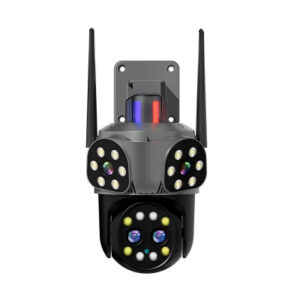
Les systèmes de surveillance traditionnels ont été construits sur une idée simple: enregistrer ce qui se passe.
Mais la sécurité moderne exige quelque chose de très différent : comprenez, piste, et répondez en temps réel.
C'est là que le 2Caméra MP PTZ change fondamentalement le jeu.
Contrairement aux caméras fixes qui capturent passivement un seul angle, la caméra WiFi ANJIA 2MP PTZ introduit l'intelligence du mouvement, couverture panoramique, et le suivi actif – transformant la surveillance en un système réactif plutôt qu'en un outil passif.
1. Les caméras fixes sont des « yeux statiques » – les caméras PTZ sont une « vision active »
Une caméra de sécurité traditionnelle est limitée par sa conception:
il voit une direction, à une hauteur, sans conscience du mouvement en dehors de son cadre.
Cela crée trois faiblesses structurelles:
- Angles morts dans les coins et les bords
- Aucune capacité à suivre le mouvement
- Nécessite plusieurs unités pour une couverture complète
Une caméra de sécurité WiFi PTZ, cependant, se comporte différemment.
Au lieu d'une vue statique, il bouge activement:
- Poêle (rotation gauche/droite)
- Inclinaison (mouvement haut/bas)
- Zoom (mise au point sur les détails en cas de besoin)
Le résultat est une seule caméra WiFi PTZ intérieure remplaçant plusieurs unités fixes..

2. La vraie mise à niveau: De « l’enregistrement » au « suivi »
Ce qui différencie véritablement une caméra PTZ 2MP des systèmes traditionnels, c'est l'intelligence., pas seulement le mouvement.
Le modèle ANJIA intègre une logique d'IA qui fait passer la surveillance en mode proactif:
Flux d'événements:
Mouvement détecté → Humain identifié → Réorientation de la caméra → Suivi de cible activé
Ce n'est plus un enregistrement passif.
Cela devient une surveillance sensible au comportement.
Les capacités clés incluent:
- Détection humaine intelligente
- 360° suivi automatique
- Alertes en temps réel sur les appareils mobiles
C'est là que l'intérêt d'une caméra WiFi PTZ sans fil devient évident : la sécurité ne dépend plus de l'observation humaine..

3. Pourquoi la résolution (2Député) Cela compte toujours dans un système PTZ intelligent
Les gens sous-estiment souvent le 2MP, mais dans les systèmes PTZ, la résolution fonctionne différemment des caméras fixes.
Parce que la caméra bouge et suit les cibles, la clarté est nécessaire pendant:
- Identification zoomée
- Moments de reconnaissance faciale
- Instantanés de suivi de mouvement
La caméra WiFi ANJIA 2MP PTZ maintient la clarté tout en ajustant dynamiquement les angles, garantir que les détails critiques ne sont pas perdus pendant le mouvement.
4. Une caméra ou plusieurs caméras: Changement d’efficacité structurelle
Dans les configurations traditionnelles, la couverture de toute la pièce nécessite généralement:
- 2–4 caméras fixes par pièce
- Câblage complexe
- Plusieurs flux de stockage
Une caméra de sécurité PTZ WiFi change complètement cette structure.
Au lieu d'évoluer horizontalement (plus de caméras), il évolue intelligemment (une unité mobile).
Impact pratique:
- Coût d'installation réduit
- Moins d'entretien
- Interface de surveillance unifiée
- Angles morts réduits
C'est pourquoi les systèmes de caméras WiFi PTZ intérieures remplacent rapidement les configurations existantes..

5. L'intégration de la maison intelligente modifie la logique de sécurité
Le système ANJIA n'est pas un matériel isolé : il s'intègre dans un environnement plus vaste.
À travers 433 connectivité, la caméra peut interagir avec:
- Alarmes intelligentes
- Capteurs de porte
- Systèmes d'éclairage
Cela signifie que la sécurité n'est plus basée sur les caméras, mais plutôt sur l'automatisation basée sur le système..
Une caméra PTZ 2MP n'est donc pas qu'un simple appareil, mais un nœud dans un écosystème intelligent.
6. Vision à double lumière = conscience toujours active
La sécurité n'est pas seulement une exigence de jour.
Le système ANJIA intègre deux sources lumineuses:
- Imagerie en couleur pour une visibilité détaillée
- Mode infrarouge pour une obscurité totale
Cela garantit que la caméra WiFi PTZ sans fil maintient une connaissance de la situation. 24/7, quelles que soient les conditions d'éclairage.
7. L'avantage caché: Couche d'interaction (Pas seulement la surveillance)
La plupart des gens pensent que les caméras sont des outils visuels.
Les systèmes PTZ modernes sont en réalité des outils de communication.
Avec audio bidirectionnel intégré:
- Vous pouvez parler aux membres de votre famille à distance
- Gérer le personnel en temps réel
- Surveillez les animaux de manière interactive
Combiné avec la suppression du bruit et l'annulation de l'écho, le système devient un pont de communication en temps réel, pas seulement un enregistreur.
8. Là où les caméras traditionnelles échouent – les systèmes PTZ excellent
| Scénario | Limitation fixe de la caméra | 2Avantage de la caméra MP PTZ |
|---|---|---|
| Grandes pièces | Nécessite plusieurs appareils | Un système rotatif |
| Suivi des mouvements | Impossible | Suivi automatique activé |
| Surveillance de nuit | Clarté limitée | Vision adaptative à double lumière |
| Interaction à distance | Aucun | Communication bidirectionnelle |
| Intégration intelligente | Faible | 433 soutien à un écosystème intelligent |
Aperçu final: Le vrai changement n’est pas matériel, c’est la logique
La plus grande différence entre une caméra traditionnelle et une caméra PTZ 2MP n'est pas l'objectif ou la résolution..
C'est la logique opérationnelle:
- Caméras fixes = observateurs passifs
- Systèmes PTZ = nœuds de sécurité décisionnels actifs
La caméra WiFi ANJIA 2MP PTZ représente clairement cette transition : passer de la surveillance statique à l'intelligence adaptative.