Traditional surveillance systems were built on a simple idea: record what happens.
But modern security demands something very different—understand, track, and respond in real time.
This is where the 2MP PTZ camera fundamentally changes the game.
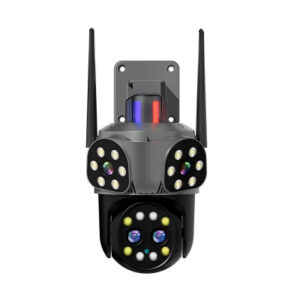
Unlike fixed cameras that passively capture a single angle, the ANJIA 2MP PTZ WiFi camera introduces motion intelligence, panoramic coverage, and active tracking—turning surveillance into a responsive system rather than a passive tool.
1. Fixed Cameras Are “Static Eyes” — PTZ Cameras Are “Active Vision”
A traditional security camera is limited by design:
it sees one direction, at one height, with no awareness of movement outside its frame.
That creates three structural weaknesses:
- Blind spots in corners and edges
- No ability to follow movement
- Requires multiple units for full coverage
A PTZ WiFi security camera, however, behaves differently.
Instead of one static view, it actively moves:
- Pan (left/right rotation)
- Tilt (up/down movement)
- Zoom (detail focus when needed)
The result is a single indoor PTZ WiFi camera replacing multiple fixed units.

2. The Real Upgrade: From “Recording” to “Tracking”
What truly separates a 2MP PTZ camera from traditional systems is intelligence, not just movement.
The ANJIA model integrates AI logic that shifts surveillance into a proactive mode:
Event Flow:
Motion Detected → Human Identified → Camera Reorients → Target Tracking Activated
This is not passive recording anymore.
It becomes behavior-aware monitoring.
Key capabilities include:
- Intelligent human detection
- 360° automatic tracking
- Real-time alerts to mobile devices
This is where the value of a wireless PTZ WiFi camera becomes obvious—security is no longer dependent on human observation.

3. Why Resolution (2MP) Still Matters in a Smart PTZ System
People often underestimate 2MP, but in PTZ systems, resolution works differently than fixed cameras.
Because the camera moves and tracks targets, clarity is needed during:
- Zoomed-in identification
- Facial recognition moments
- Motion tracking snapshots
The ANJIA 2MP PTZ WiFi camera maintains clarity while dynamically adjusting angles, ensuring critical details are not lost during movement.
4. One Camera vs Multiple Cameras: Structural Efficiency Shift
In traditional setups, full-room coverage typically requires:
- 2–4 fixed cameras per room
- Complex wiring
- Multiple storage streams
A PTZ WiFi security camera changes this structure entirely.
Instead of scaling horizontally (more cameras), it scales intelligently (one moving unit).
Practical impact:
- Lower installation cost
- Less maintenance
- Unified monitoring interface
- Reduced blind spots
This is why indoor PTZ WiFi camera systems are rapidly replacing legacy setups.

5. Smart Home Integration Changes the Security Logic
The ANJIA system is not isolated hardware—it integrates into a larger environment.
Through 433 connectivity, the camera can interact with:
- Smart alarms
- Door sensors
- Lighting systems
This means security is no longer camera-based—it becomes system-based automation.
A 2MP PTZ camera is therefore not just a device, but a node in a smart ecosystem.
6. Dual Light Vision = Always-On Awareness
Security is not only a daytime requirement.
The ANJIA system integrates dual light sources:
- Full-color imaging for detailed visibility
- Infrared mode for total darkness
This ensures the wireless PTZ WiFi camera maintains situational awareness 24/7, regardless of lighting conditions.
7. The Hidden Advantage: Interaction Layer (Not Just Monitoring)
Most people think cameras are visual tools.
Modern PTZ systems are actually communication tools.
With built-in two-way audio:
- You can speak to family members remotely
- Manage staff in real time
- Monitor pets interactively
Combined with noise suppression and echo cancellation, the system becomes a real-time communication bridge, not just a recorder.
8. Where Traditional Cameras Fail — PTZ Systems Excel
| Scenario | Fixed Camera Limitation | 2MP PTZ Camera Advantage |
|---|---|---|
| Large rooms | Needs multiple devices | One rotating system |
| Movement tracking | Impossible | Auto-follow enabled |
| Night monitoring | Limited clarity | Dual-light adaptive vision |
| Remote interaction | None | Two-way communication |
| Smart integration | Weak | 433 smart ecosystem support |
Final Insight: The Real Shift Is Not Hardware—It’s Logic
The biggest difference between a traditional camera and a 2MP PTZ camera is not the lens or resolution.
It is the operational logic:
- Fixed cameras = passive observers
- PTZ systems = active decision-making security nodes
The ANJIA 2MP PTZ WiFi camera represents this transition clearly—moving from static surveillance to adaptive intelligence.